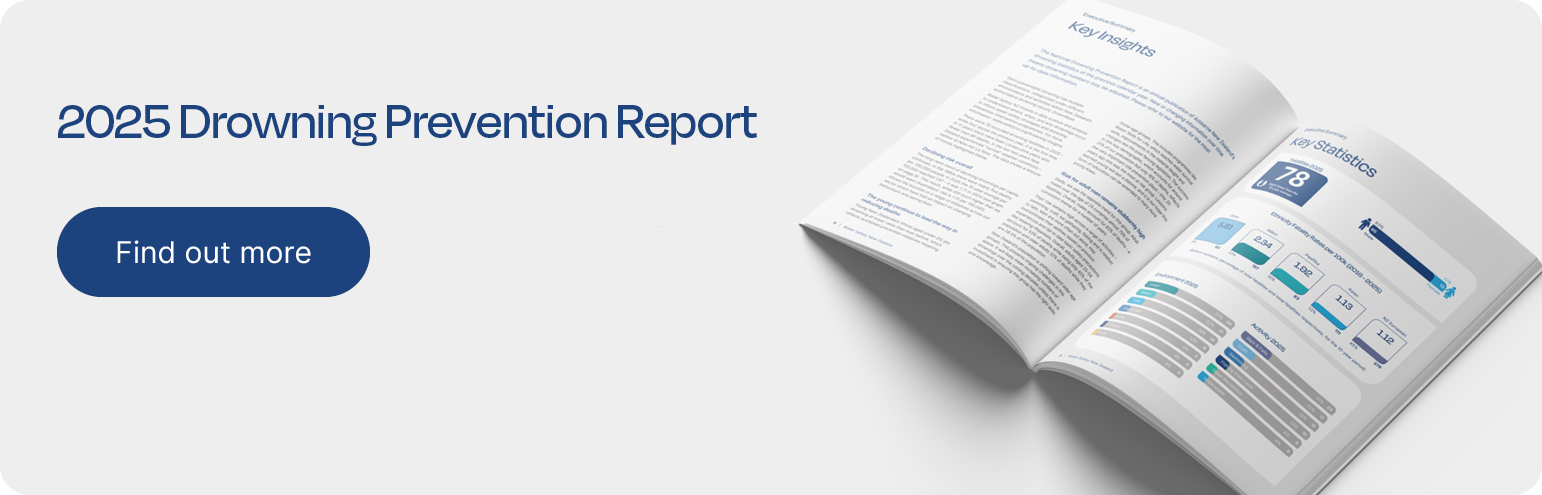
Drowning remains New Zealand’s leading recreational killer, with 78 people losing their lives in 2025 – more than half of those were undertaking water activities by themselves, according to Water Safety New Zealand’s Drowning Prevention Report 2025.
The total figure is four more than 2024, but importantly eight fewer than the 10-year average, continuing a long-term decline in drownings per capita – a trend being led by young people. In the 1980s, drowning rates approached five deaths per 100,000 people. The 10-year average has now fallen to 1.67 per 100,000 in 2025 (1.71 in 2024), reflecting sustained prevention and rescue work across the water safety sector.
However, that progress is not evenly shared. Youth drowning rates are declining, but adult and older adult males remain the highest-risk group. Māori and Pasifika communities continue to be over-represented in the statistics, and risk among Asian New Zealanders has increased in recent years.
“Each of the 78 people lost in 2025 are our family, friends and loved ones. We believe one death is too many,” says Water Safety NZ Chief Executive Glen Scanlon
A defining theme of this year’s report is the risk of being alone in or around water. In 2025, 43 deaths - 55 per cent of all fatalities - involved people who were by themselves, two higher than the 10-year average. It is aconsistent issue. Adults and older adults made up the majority of those deaths. Over the past decade there have been 408 drowning deaths where the person was alone, 310 of them male.
“When you are by yourself and unexpectedly get into trouble in the water, the margin for survival disappears,” says Scanlon. “Changing adult behaviour remains one of the biggest challenges in drowning prevention, particularly among adult males.”
The report is released as New Zealand considers the Life Jackets for Children & Young Persons Bill – described as a once-in-a-generation opportunity to significantly reduce drowning. Data modelling from Water Safety NZ shows that 12 lives could be saved every year if lifejackets were worn on all watercrafts. The organisation points to the success of 1990s pool-fencing legislation as clear evidence that targeted regulation and government intervention can dramatically reduce risk and change behaviour at scale.
Land-based fishing continues to present serious risk. There were 10 such deaths in 2025 - well above the 10-year average of six - and all were male. Most occurred in coastal locations, including known high-risk sites such as Papanui Point. Water Safety NZ continues to urge people to never fish from rocks alone and to always wear a lifejacket.
In spite of young people leading the long-term decline in drowning deaths, progress is under pressure. In 2025, ACC ceased $1.1 million in funding that had supported water-safety training for approximately 20,000 children annually, particularly those in high-need communities unable to afford private lessons. Water Safety NZ is exploring alternative funding to maintain delivery and protect children, including via Government, corporates and through philanthropists.
“Our long-term goal is to make sure at least 60 per cent of all school-aged children have access to quality water safety programmes. About 150,000 children miss out now. Protecting our next generation of New Zealanders with water safety skills and knowledge is fundamental to preventing drowning.”
Scanlon says investment in water safety is not merely a funding gap – it is an impending deficit in public safety.
“This commitment transcends party lines. The investment prevention needs is a drop in the ocean when compared with the range of other decisions Governments make in relation to spending – a small investment which could easily be tripled and still return much more than it costs.”
Regionally, Northland, Auckland, Waikato, and the Bay of Plenty accounted for 51 of the 78 deaths, reflecting the high levels of water interaction in the upper North Island.
“The report reinforces a simple but critical prevention message in every region,” says Scanlon. “Don’t go alone. Wear a lifejacket. Avoid high-risk locations.
“New Zealand’s drowning rate is improving, but preventable deaths remain unacceptably high. With legislation, education and behaviour change aligned, our country has a rare opportunity to significantly reduce future loss of life. While the report highlights the risks of being alone, water safety itself is a collective effort – from local communities and whānau to sector partners across Aotearoa. We thank all of those people for their hard work. It is important we work together to build a stronger culture of water safety. We hope that today’s report will support that.”